Painting the Dark: Light, Shadow & the Drama of Contrast - Royal Talens

Autumn has a way of changing the light.

Days grow shorter. Shadows stretch across the landscape. Interiors seem warmer as the world outside grows darker. A window illuminated at dusk suddenly feels more inviting, or perhaps a little mysterious. October reminds us that light is something we notice most when it is surrounded by darkness.

Artists have understood this relationship for centuries. Light and shadow can describe form and create depth, but they can also establish mood, direct our attention, and tell a story. Sometimes what an artist chooses not to reveal is every bit as important as what we are allowed to see.

Out of the Darkness

During the Renaissance, artists developed chiaroscuro, literally "light-dark," using gradual changes in value to give figures and objects a convincing sense of volume.

By the Baroque period, artists such as Caravaggio pushed this relationship toward something much more dramatic. His use of tenebrism placed brightly illuminated figures against deep areas of darkness. Light no longer simply described form. It became theatrical.

But dramatic contrast isn't unique to the Western tradition.

Japanese ukiyo-e artists such as Utagawa Hiroshige approached nighttime very differently. Rather than relying on gradual modelling, Hiroshige often used flattened shapes, silhouettes, moonlight, lanterns, and expanses of darkness to establish atmosphere.

A figure crossing a bridge might become little more than a dark shape. A glowing window or lantern could punctuate an otherwise subdued scene.

Caravaggio and Hiroshige offer very different solutions to the same visual problem: how do you make us experience light?

The answer, perhaps surprisingly, is through darkness.

Caravaggio
The Conversion on the Way to Damascus, 1601
Oil on canvas

When Shadows Tell Stories

By the modern era, shadows increasingly became psychological.

In the mysterious plazas of Giorgio de Chirico, impossibly long shadows stretch across nearly empty architectural spaces. We may not know exactly what has happened, but the paintings make us feel that something has, or that something is about to.

Edward Hopper found similar drama in ordinary American life. A diner glowing against a dark street, sunlight cutting across a room, or an illuminated window surrounded by darkness can turn an everyday scene into a narrative.

This visual language extends beyond painting. Film noir transformed hard directional lighting, silhouettes, deep shadows, illuminated doorways, and dramatic angles into a vocabulary of mystery and suspense. Light doesn't simply allow us to see the characters. It controls how much we are permitted to know.

That cinematic sensibility can also be found in the psychologically charged work of Paula Rego. Her figures often appear caught in the middle of a scene already underway. Dramatic value relationships reinforce the tension, allowing shadow to become part of the story.

Giorgio de Chirico
Mystery and Melancholy of a Street, 1914
Oil on canvas

Shadow Has Colour

There is another important lesson hidden in all this darkness:

A shadow isn't simply black.

Few artists demonstrated this more beautifully than Claude Monet. For the Impressionists, shadows were filled with colour and affected by the same changing conditions of light as everything around them. In Monet's paintings of snow, haystacks, buildings, and landscapes, shadows can become blue, violet, pink, or green depending upon the surrounding light and atmosphere.

Look carefully and shadows can contain colours reflected from surrounding objects. A warm light may produce a comparatively cool shadow. A blue sky can influence shadows across a landscape. Reflected light can introduce unexpected colour into even the darkest passage.

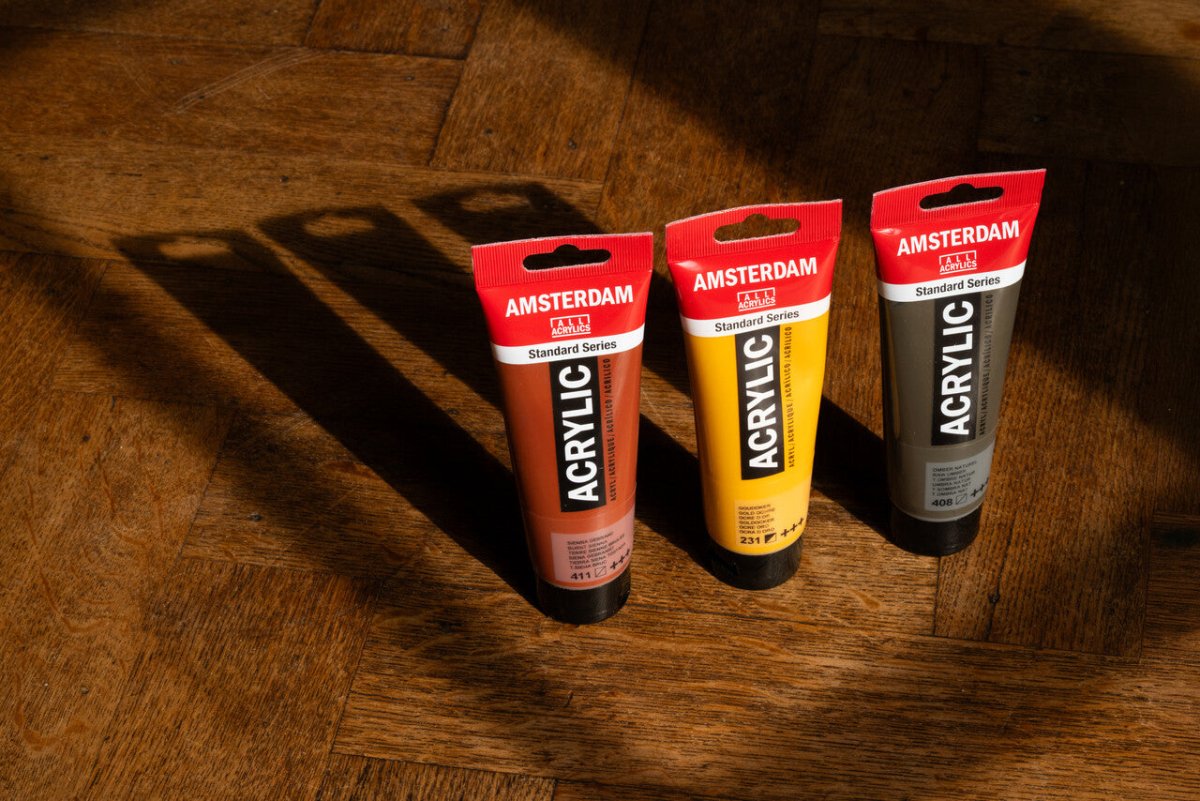
Acrylic painters can explore this by mixing chromatic darks rather than automatically reaching for black. Try combining Ultramarine Blue with Burnt Sienna. Adjusting the proportions allows the mixture to move between warmer and cooler near blacks while retaining a subtle sense of colour.

Black remains a powerful and versatile colour on the palette but exploring chromatic darks and other colour combinations can open the door to a greater variety of temperatures, effects, and possibilities.

The goal isn't simply to make something darker. It is to make the darkness alive.

Claude Monet
Haystack (Les Meules)
1890–1891
Oil on canvas

From Shadow to Shape

We can take this idea one step further. What happens when we stop thinking of a shadow as something attached to an object and begin seeing it simply as a shape?

This is something I discovered early in my own development as a painter. As a student, I would take a painting or photograph and reduce it to only its darkest and lightest values. The image became a collection of shapes rather than objects. It was a simple exercise, but it taught me something I still carry into my work today: a shadow can be a shape, a colour, and an essential part of the composition.

David Hockney offers a wonderful example. In many of his California paintings, shadows become simplified shapes of colour. They don't merely describe the absence of light. They establish structure, rhythm, and movement within the composition.

Take representation away altogether and the principle remains. The bold black-and-white paintings of Franz Kline demonstrate how strongly our eyes respond to opposing values. Robert Motherwell used massive dark forms against lighter grounds to create rhythm, weight, and emotional gravity.

Contrast itself can become the subject.

David Hockney
Green Pool with Diving Board and Shadow, 1978
Paper pulp painting on paper

Try It: Paint the Dark

This October, experiment with making darkness an active part of your painting.

Place a simple object under a strong directional light and paint its shadows without using black. Mix chromatic darks and look carefully for reflected colour.

Try painting a nocturne using only a few areas of illumination. Turn a figure or object into a silhouette and allow the surrounding negative space to define it.

Or try the exercise I discovered as a student. Choose a painting or photograph and reduce it to only two values: light and dark. Forget about the objects and concentrate on the shapes they create. Then take it one step further and turn those shapes into colour.

For something a little more mysterious, let the shadow become the storyteller. Paint an ordinary object, figure, doorway, or window, but allow its shadow to suggest something unexpected.

After all, October is the perfect month to let a little mystery into the studio.

Light reveals. Shadow conceals. And somewhere between the two, a painting begins to tell its story.

About the Author

Jeff Olson is a Seattle based artist with more than thirty years of studio practice and exhibition experience. He is both a painter and an educator with a deep understanding of the materials that shape visual expression.

He is the Art Education Director for Royal Talens North America, where he shares his knowledge with universities, art organisations and professional events throughout the United States and Canada. His work focuses on the history, composition and expressive potential of artists materials. Find out more about Jeff on his website.

Related blogs

Painting with acrylics

Start Creating something awesome.

Welcome to your Amsterdam Acrylic Create Set. You've got the tools. Now let's make something amazing. Whether you're painting, drawing,...
Paint Like the Ocean - Royal Talens
Painting with acrylics

Paint Like the Ocean

Discover how acrylic paint can capture the movement, depth, and atmosphere of water through colour, layering, and fluid techniques inspired...
Painting the Sound of Colour with Amsterdam Acrylics - Royal Talens
Painting with acrylics

Painting the Sound of Colour with Amsterdam Acrylics

What if a painting could feel like music? Not literally, but in the way it moves, repeats, and builds. That...
Sketch your world with Amsterdam Acrylics - Royal Talens
Painting with acrylics

Sketch your world with Amsterdam Acrylics

From quiet coffee moments to busy streets, sketching helps you see more. In this blog, Jeff Olson shares how to...
The architecture of intimacy: a bridge between acrylics and oils - Royal Talens
Painting with acrylics

The architecture of intimacy: a bridge between acrylics and oils

By Ale Casanova In Eclosion, Ale Casanova explores the dialogue between acrylics and oils on a large scale. By combining the...
Get started with acrylic paint - Royal Talens
Painting with acrylics

Get started with acrylic paint

You don’t need much to get started with acrylic paint. We have listed the most important supplies for you.
Layer, combine, experiment - Royal Talens
Painting with acrylics

Layer, combine, experiment

April is a call to disrupt routine. As light returns and energy shifts, it becomes easier to invite risk back...
Women in art working with acrylics - Royal Talens
Painting with acrylics

Women in art working with acrylics

Acrylic paint has been a transformative medium in modern art, giving artists the freedom to experiment and express themselves. For...